

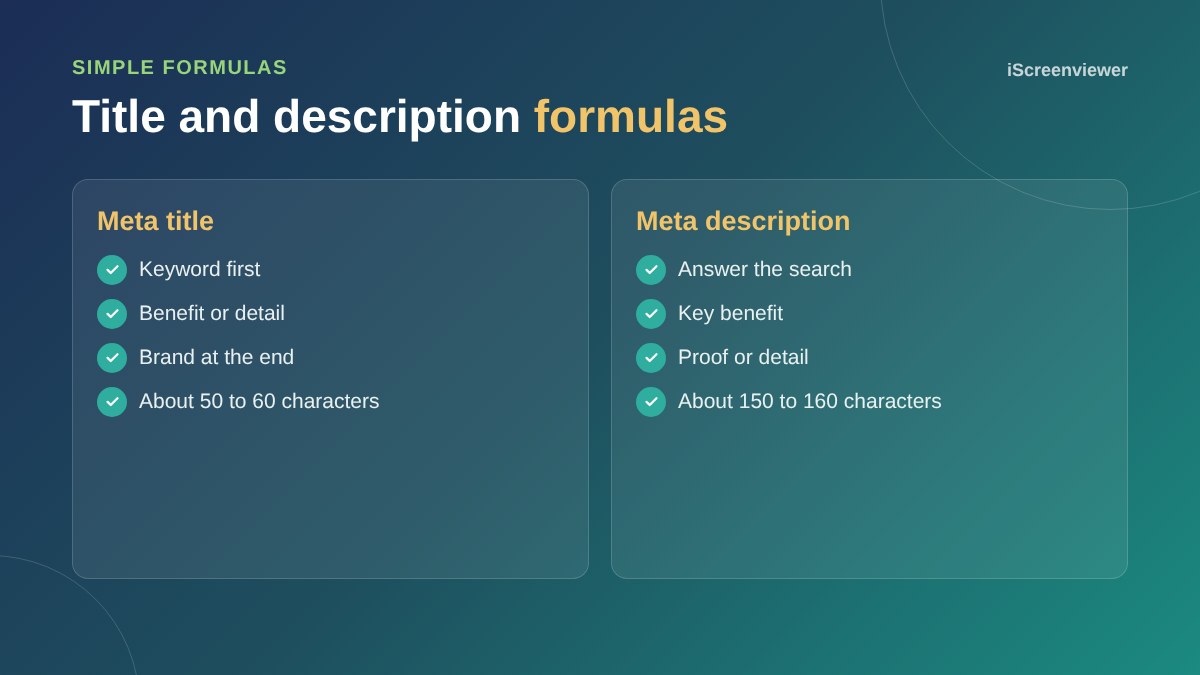
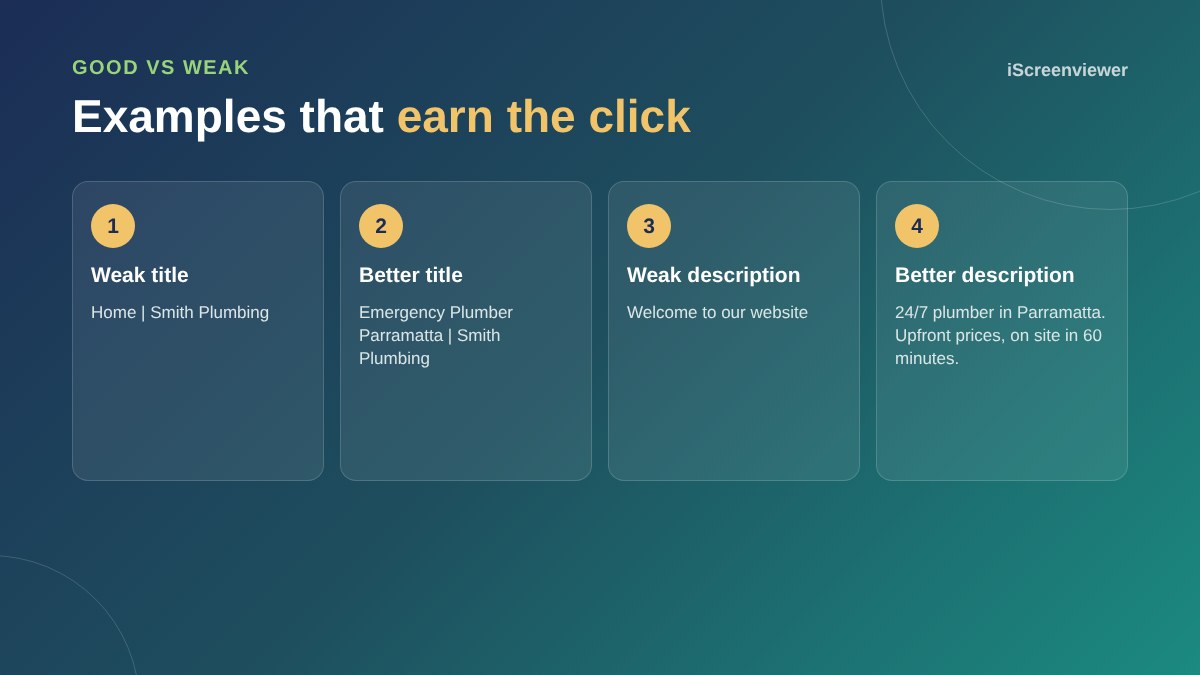
A good meta title puts the main keyword near the start, adds a reason to click and ends with your brand, in about 50 to 60 characters. A good meta description answers the search in one or two sentences, adds a benefit or proof point, and fits in about 150 to 160 characters. Every page should have its own, written for the person searching rather than for search engines.
Why they matter
Your title and description are often the first thing people see in Google. The title is a ranking signal. The description is not, but it strongly influences whether people click.
Writing meta titles
- Lead with the main keyword or topic
- Add what makes the page worth clicking: location, price, year, guide, free
- End with your brand name
- Keep it to roughly 50 to 60 characters so it is not cut off
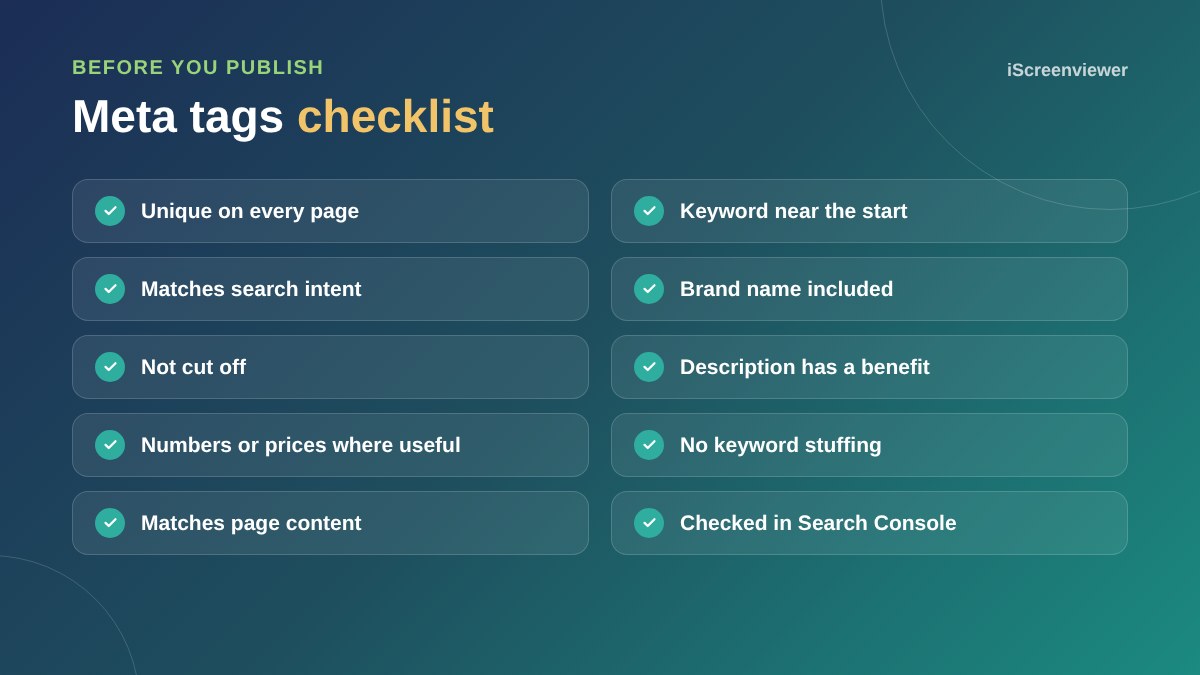
- Make it unique on every page
Writing meta descriptions
- Answer the searcher's question or need straight away
- Mention a benefit, proof point or price
- Use active, plain language
- Include the keyword naturally, as Google often bolds it
- Keep it to roughly 150 to 160 characters
Why Google rewrites them
Google sometimes shows different text if it thinks another part of the page better matches the search. You cannot stop this completely, but descriptions that clearly match the page content are rewritten less often.
Where to edit them
On WordPress, use your SEO plugin's fields on each page and post. On Shopify, use the search engine listing section at the bottom of products, collections and pages.
Find pages to improve
In Google Search Console, look for pages with lots of impressions but a low click-through rate. Better titles and descriptions on those pages can bring more visitors without needing higher rankings.
For store pages, see collection page SEO and the product listing SEO guide.
Titles for different page types
- Home page: what you do and where, plus your brand, for example Web Design Sydney | iScreenviewer
- Service page: the service and location or audience
- Product page: product name, key detail and brand
- Collection page: the product type customers search for
- Blog post: the question or topic, often as a how-to or guide
Avoid these mistakes
Do not repeat the same keyword several times, do not use all capitals, and do not promise something the page does not deliver. Misleading snippets may get a click, but visitors leave quickly, which helps no one.
Want your meta tags written for you?
Meta titles and descriptions are part of the SEO and Analytics Health Check and the Collection and Category SEO package.
Frequently asked questions
How long should a meta title be?
About 50 to 60 characters. Google cuts titles by pixel width, so shorter is safer.
How long should a meta description be?
About 150 to 160 characters, though Google may show more or less.
Do meta descriptions affect rankings?
Not directly, but they affect how many people click your result.
Why does Google change my meta description?
Google may show page text that it thinks better matches the search. Clear, relevant descriptions are rewritten less often.
Should every page have a unique meta title?
Yes. Duplicate titles make it harder for Google and searchers to tell pages apart.
Should I put my brand in the meta title?
Usually yes, at the end, separated by a vertical bar.