

Website hosting is the service that keeps your website online. It stores your website files on a server so customers can visit your site any time of day. For a small business, good hosting means a fast, secure website with backups in place, and ideally someone who looks after it so you can focus on running the business.
This guide explains what website hosting is, the main types of hosting, what to look for and what managed hosting costs for a small business in Australia.
What is website hosting?
Every website is made up of files, images and usually a database. Website hosting is the rented space on a server where all of that lives. The server is connected to the internet around the clock, so when someone types in your domain name or clicks a link to your site, the server sends them your pages.
Hosting is often confused with your domain name, but they are two different things:
- Domain name: your website address, such as yourbusiness.com.au. It is registered with a domain registrar and renewed every 1 or 2 years.
- Website hosting: the server where your website actually lives. Your domain is pointed to your hosting using DNS records.
- Email hosting: where your business mailboxes live, usually Google Workspace or Microsoft 365. Your domain also points your email to this provider using MX records.
When a website goes down, loads slowly or stops sending email after a move, the cause is usually one of these three pieces not being set up correctly.
Types of website hosting
Most small business websites are hosted on one of these options:
- Shared hosting: your website shares a server with many others. It is cheap and suits small sites, but you usually handle setup, updates and backups yourself through a control panel.
- Managed hosting: the technical work is done for you, including setup, SSL, updates, backups and monitoring. You pay a little more and get a website that is looked after.
- VPS or cloud hosting: a dedicated slice of a server with more power and control. It suits larger or busier websites, but needs technical knowledge to run.
- Platform hosting: services such as Shopify and Squarespace include hosting in their monthly plan, so no separate hosting is needed.
Shared hosting vs managed hosting
The real difference is who does the work. With shared hosting, you pay for the server space and do everything else. With managed hosting, a developer sets up the site, keeps it updated and backed up, and is the person you contact when something goes wrong.
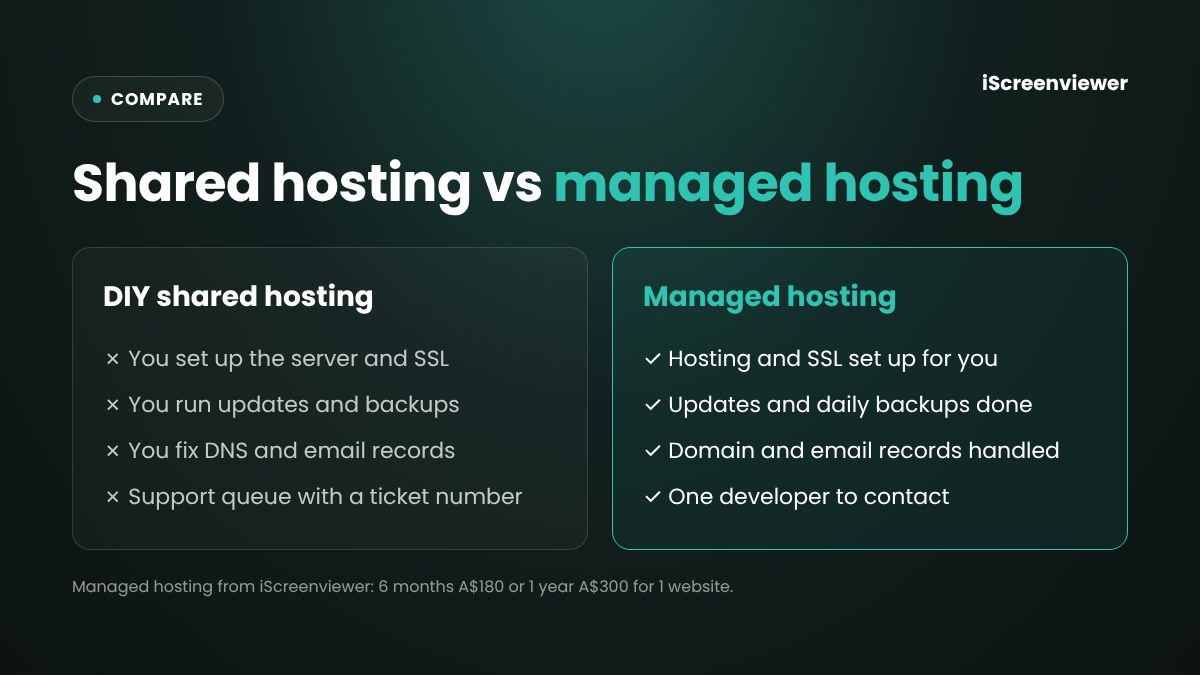
Cheap hosting is only cheap until something breaks. The value of managed hosting is knowing who will fix it, and that a recent backup is ready if they need it.
What to look for in small business hosting
Whichever option you choose, check that it covers these basics:
- Free SSL certificate: so your site loads over https and browsers do not show a "Not secure" warning.
- Daily backups: stored away from your website, with restores included if something goes wrong.
- Software updates: WordPress core, plugins and themes kept up to date to close security holes.
- Uptime and security monitoring: so problems are spotted and fixed before customers notice.
- Domain and email setup: DNS, MX, SPF and DKIM records set up correctly so your site loads and your email is delivered.
- Australian-based support: a real person in your time zone who knows your website.
- Free migration: moving from your current host without extra charges or downtime.
Why hosting matters for SEO and AI search
Hosting affects how search engines and AI assistants see your business. A slow or unreliable server leads to poor Core Web Vitals, pages that drop out of Google when they cannot be crawled, and lost visitors who leave before the page loads. Sites without SSL can be flagged as not secure. Fast, stable and secure hosting gives your SEO and content the best chance of being found in Google and recommended in AI search tools such as ChatGPT and Google AI Overviews.
How moving to new hosting works
Moving hosting sounds risky, but done properly it should be invisible to your customers. A typical move looks like this:
- You send access to your current website, domain registrar and email provider.
- The website files and database are copied to the new hosting.
- The site is tested on the new hosting before anything is switched over.
- The SSL certificate is installed and the email DNS records are copied across.
- The domain is pointed to the new hosting and everything is tested again live.
Because the website is tested before the domain is switched, there is little to no downtime, and email keeps working because the MX, SPF and DKIM records are set up before the switch.
How much does website hosting cost?
Basic shared hosting in Australia can start from a few dollars a month, but that price usually covers the server only. Setup, migration, updates, backups and support are extra, or left to you. Managed hosting costs more because that work is included.
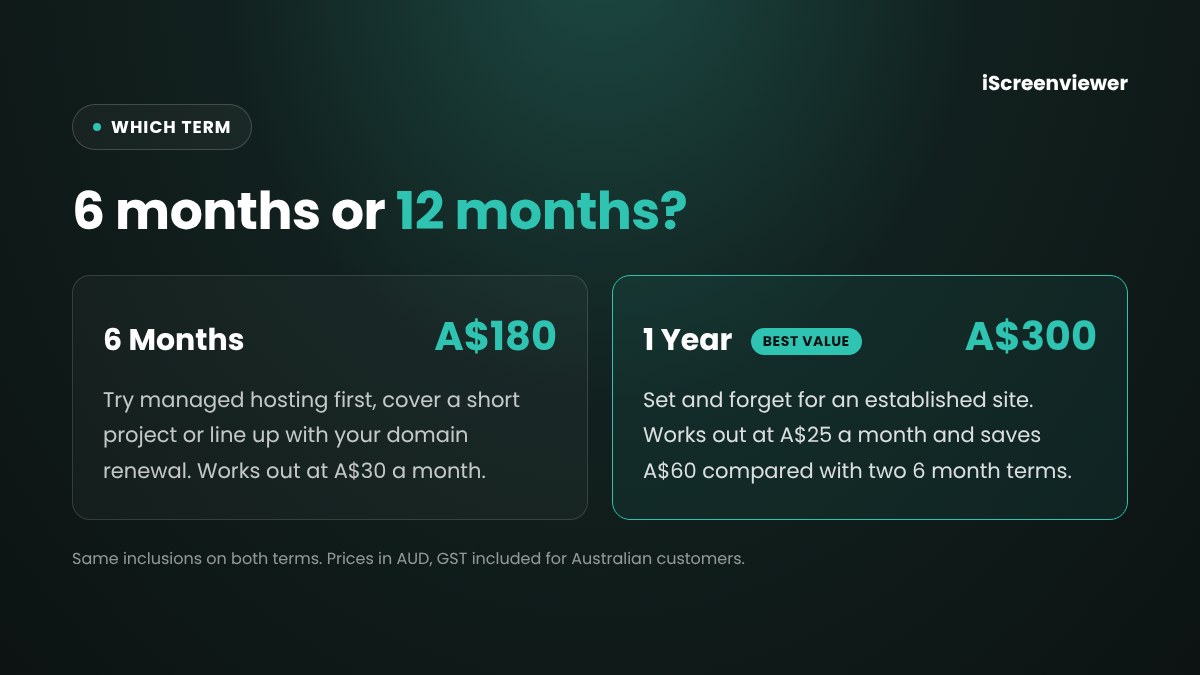
iScreenviewer offers managed hosting for 1 website with two term options:
- 6 Months: A$180 (A$30 a month). Good if you want to try managed hosting first or only need cover for a short time.
- 1 Year: A$300 (A$25 a month). Best value for established websites, saving A$60 compared with two 6 month terms.
Both terms include hosting setup or migration, domain and email setup, WordPress updates, daily backups, free SSL, uptime and security monitoring and support from a Sydney-based developer. Prices are in AUD, with GST included for Australian customers.
Ready to get your hosting sorted?
If you would rather not deal with control panels, renewals and support queues, managed hosting gives you a fast, secure website and one person to contact. Choose 6 months or 1 year and I will be in touch within one business day, or start a project brief if you need a new website built as well.
Frequently asked questions
What is website hosting?
Website hosting is the service that stores your website files and database on a server connected to the internet, so people can visit your site 24 hours a day. When someone types your domain name, the domain points to your hosting and the server sends them your website.
What is the difference between a domain and hosting?
A domain is your website address, such as yourbusiness.com.au. Hosting is the server space where the website itself lives. You need both: the domain is registered with a domain registrar and is pointed at your hosting using DNS records.
What is managed website hosting?
Managed website hosting is hosting where a developer or provider looks after the technical work for you, including setup, SSL, software updates, backups and monitoring. You get a working, secure website without logging into a control panel or contacting a support queue.
How much does website hosting cost for a small business in Australia?
Basic shared hosting can start from a few dollars a month, but you do the setup, updates and backups yourself. Managed hosting usually costs more because the work is done for you. iScreenviewer offers managed hosting for 1 website at A$180 for 6 months or A$300 for 1 year, with setup and migration included.
Will moving hosting affect my email?
It can if the email DNS records are missed. Your MX, SPF and DKIM records tell the internet where to deliver your email and that it is genuine. A careful move copies these records to the new DNS setup first, so email keeps working with no interruption.
Does a Shopify store need website hosting?
No. Shopify hosts every store on its own platform, so you do not need separate hosting. Website hosting is for WordPress websites, WooCommerce stores and static HTML websites.
How long does it take to move a website to new hosting?
Most small business websites can be moved within 2 business days once access is provided. The site is copied and tested on the new hosting first, then the domain is switched over, so there is little to no downtime.