

More of your customers are asking questions in Google AI Overviews, ChatGPT, Copilot and Perplexity instead of scrolling through ten blue links. If your business is not part of those answers, you are missing enquiries you never knew existed.
The good news is that getting found in AI search is not magic. It comes down to three things most small business websites skip: keyword planning, schema markup and a few technical checks for AI search visibility.
In this guide I'll explain each one in plain English, show you what to check on your own site and how to fix the gaps.
Quick Answer: How Do You Get Found in AI Search?
To get found in AI search, make sure your site can be crawled by Google, Bing and AI search bots, plan one clear keyphrase per page, answer customer questions directly near the top of each page, and add accurate schema markup (structured data) that describes your business, services and products. AI tools build their answers from pages they can access, understand and trust.
What Is AI Search Visibility?
AI search visibility is how often your business is found, cited or recommended when someone uses an AI-powered search tool. The main ones in Australia today are:
- Google AI Overviews and AI Mode, the AI summaries at the top of Google results
- ChatGPT search, which draws on third-party search providers including Bing, plus OpenAI's own crawler
- Microsoft Copilot, powered by Bing
- Perplexity, which cites its sources with links
All of them rely on the same basics as traditional SEO: pages that can be crawled and indexed, content that clearly answers a question and signals that your business is real and trustworthy. Google has said there is no special optimisation needed for AI Overviews beyond good SEO practice, which is why the foundations below matter so much.
Step 1: Keyword Planning for Search and AI
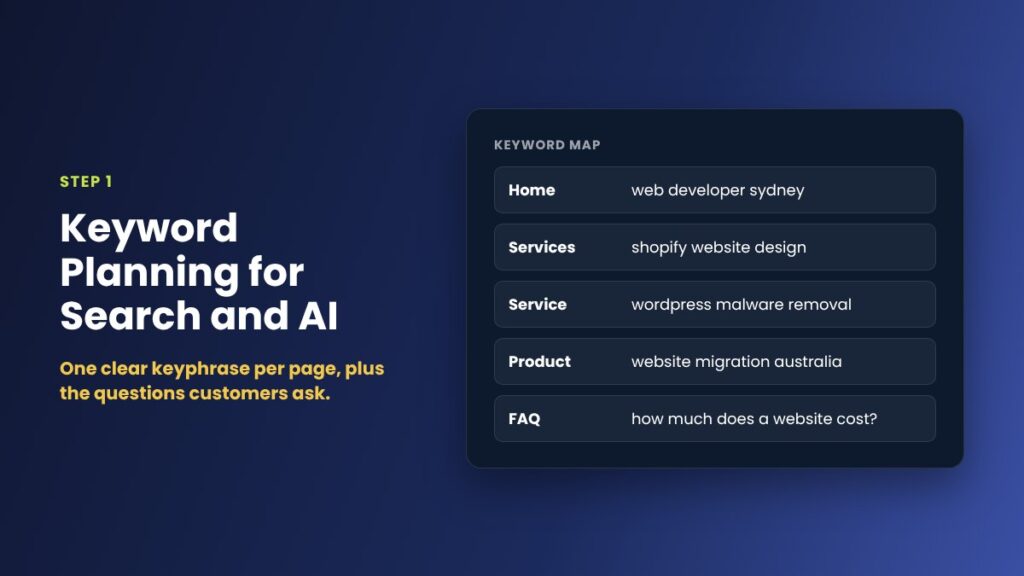
Keyword planning is where most websites go wrong. Pages are written without a clear focus, so Google and AI tools can't tell which page best answers a question. A keyword plan fixes this by mapping one main keyphrase to each important page.
How to build a simple keyword plan
- List your 10 most important pages: home, key services or categories and your best-selling products.
- For each page, choose one primary keyphrase people actually search, such as "emergency plumber Parramatta" rather than "plumbing solutions".
- Add two or three supporting terms and the questions customers ask, using Google's "People also ask" box, Search Console and your own enquiries.
- Check that no two pages target the same keyphrase, so they don't compete with each other.
- Use the keyphrase in the page title, H1, first paragraph, meta description and image alt text.
Questions are especially valuable for AI search. People type full questions into ChatGPT and Google AI Mode, so pages that answer "how much does…", "what is the best…" and "do I need…" questions in plain language are more likely to be quoted.
Step 2: Schema Markup (Structured Data)
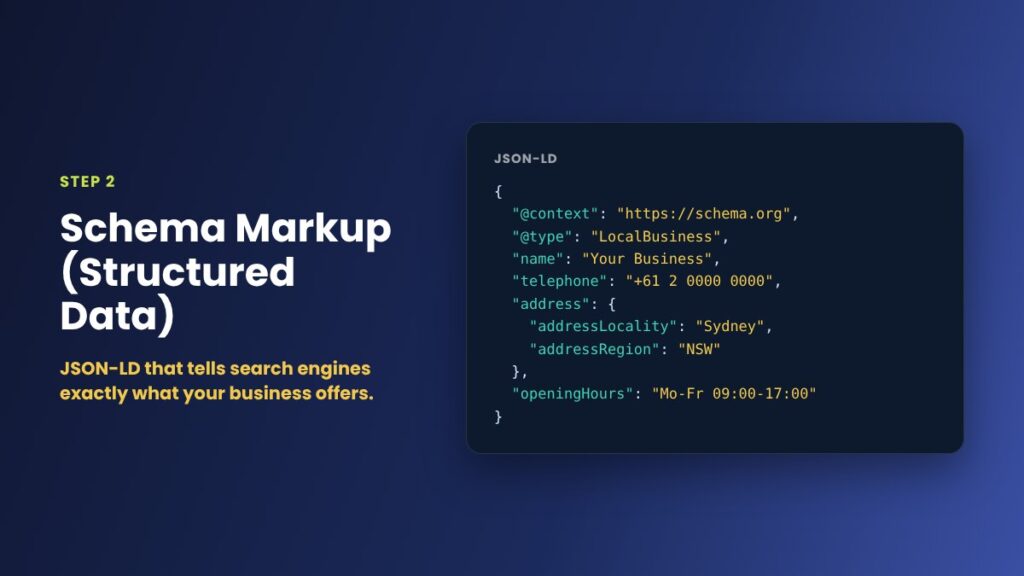
Schema markup is code, usually in JSON-LD format, that tells search engines exactly what is on a page: who your business is, where you are, what you sell, your prices and your FAQs. Visitors don't see it, but Google, Bing and other tools read it.
Here are the schema types most small business websites should have:
| Schema type | Where to use it | What it tells search engines |
|---|---|---|
| Organization or LocalBusiness | Home and contact pages | Business name, logo, address, phone, hours and social profiles |
| WebSite and BreadcrumbList | Site-wide | Site name and how pages fit into your site structure |
| Product and Offer | Product pages | Product name, price, availability and reviews |
| Service | Service pages | What you offer and the area you serve |
| Article | Blog posts and guides | Headline, author, publish date and images |
| FAQPage | Pages with FAQs | The questions and answers on the page |
A few things to know before you add schema:
- Schema must match what is visible on the page. Marking up reviews or prices that customers can't see breaks Google's guidelines.
- Many plugins and themes add basic schema, but it is often incomplete or duplicated. Check before adding more.
- Since 2023, Google only shows FAQ rich results for a small number of authoritative government and health sites, but FAQ schema still helps search engines understand your content.
- Always test your markup with Google's Rich Results Test and the Schema Markup Validator.
Step 3: Technical Checks for AI Search Visibility
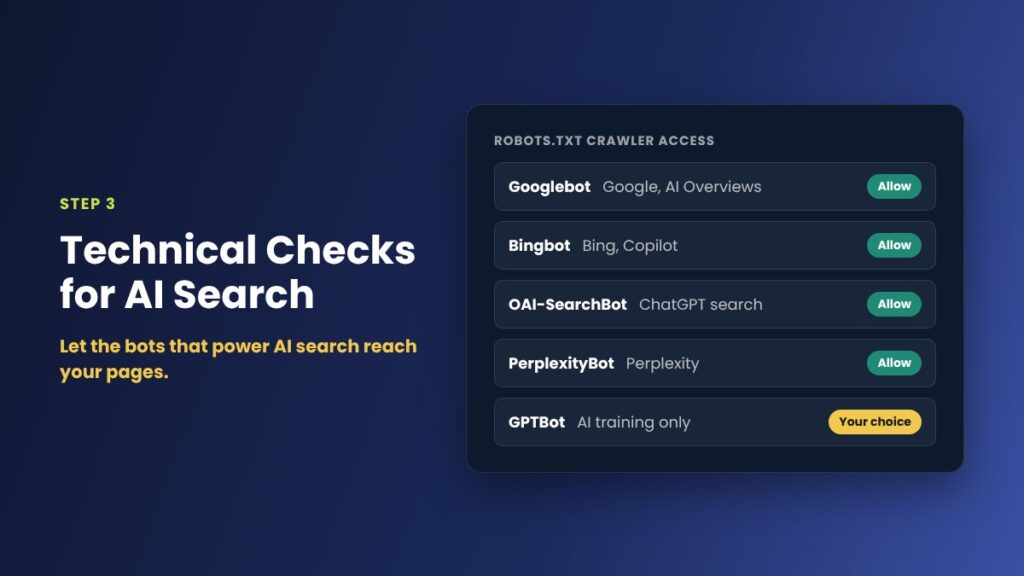
Even great content can't be cited if AI tools can't reach it. These checks take less than an hour and are often overlooked.
Check your robots.txt for AI crawlers
Open yoursite.com.au/robots.txt and make sure you are not blocking the bots that power AI search:
- Googlebot for Google Search, AI Overviews and AI Mode
- Bingbot for Bing, Copilot and part of ChatGPT search
- OAI-SearchBot for ChatGPT search results
- PerplexityBot for Perplexity
Note that blocking Google-Extended or GPTBot controls whether your content is used to train AI models. It does not remove you from Google Search or ChatGPT search results, so you can block training while still being visible.
Set up Bing Webmaster Tools
Many Australian businesses have Google Search Console but have never set up Bing Webmaster Tools. Because Copilot and ChatGPT search lean on Bing, verifying your site and submitting your sitemap there is one of the quickest wins for AI visibility. You can import your site directly from Search Console in a few clicks.
Keep your business details consistent
AI tools cross-check information from many sources. Make sure your business name, address, phone number, hours and services match across your website, Google Business Profile, Facebook, LinkedIn and directory listings.
Step 4: Write Content AI Tools Can Quote
AI search tools favour content that gets to the point. On each key page:
- Start with a short, direct answer to the main question in the first two or three sentences.
- Use clear headings that match the questions people ask.
- Include specific details: prices or price ranges, locations served, turnaround times and who the service is for.
- Add a short FAQ section covering real customer questions.
- Show who is behind the business, with an about page, real photos and reviews.
How to Check Your AI Search Visibility
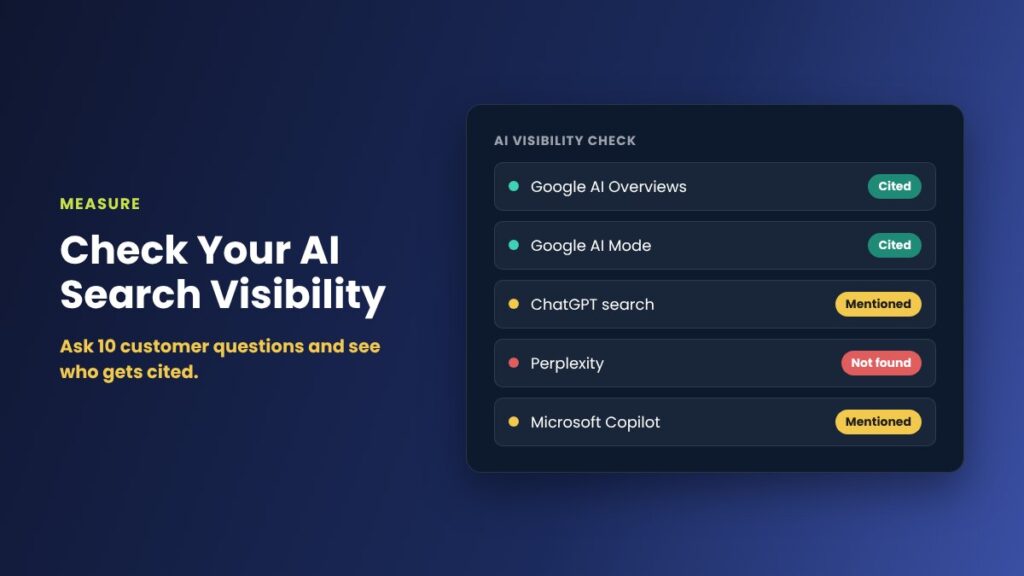
Make a list of 10 questions a customer might ask before buying from you, such as "who does website migrations in Sydney?" or "best pizza steel in Australia". Ask each one in Google, ChatGPT and Perplexity and note:
- Whether your business is mentioned or cited
- Which competitors appear instead
- Which sources the AI tool links to
Repeat the check every few months. In Google Search Console, AI Overview and AI Mode traffic is included in your regular Performance report, so keep an eye on impressions and clicks for your target keyphrases too.
Get Keyword Planning, Schema and AI Search Visibility Done for You
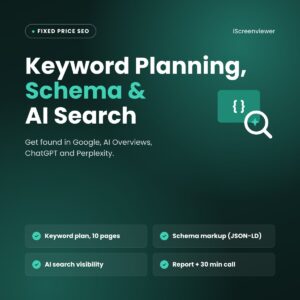
If you would rather have it done for you, my Keyword Planning, Schema Markup and AI Search Visibility package is a fixed price of A$599.
It includes a keyword plan and on-page updates for up to 10 key pages, JSON-LD schema markup tested in Google's tools, AI crawler and Bing Webmaster Tools checks, answer-first summaries and FAQs, a baseline AI visibility check and a 30-minute call to walk through the results.
View the package or request a custom quote for a larger site.
Related Articles
- SEO and Analytics Health Check: 10 Signs Your Website Needs an Audit
- How to Write Product Listings That Rank on Google (Shopify and WooCommerce)
- Fixed-Price Website Packages for Shopify, WooCommerce and WordPress
- How to Brief a Web Developer: 6 Things to Know Before You Start
Frequently Asked Questions About AI Search Visibility
What is AI search visibility?
AI search visibility is how often your business is found, cited or recommended in AI-powered search results such as Google AI Overviews, AI Mode, ChatGPT search, Microsoft Copilot and Perplexity.
Is SEO still important with AI search?
Yes. AI search tools pull their answers from pages they can crawl and trust, and Google uses the same core ranking systems for AI Overviews as it does for regular results. Strong SEO is the foundation of AI search visibility.
Does schema markup help with AI Overviews?
Google says no special schema is required to appear in AI Overviews, but accurate structured data helps search engines understand your business, products and content, and it is still needed for rich results such as product prices and reviews.
How do I get my business mentioned in ChatGPT?
Make sure OAI-SearchBot and Bingbot are not blocked, submit your sitemap to Bing Webmaster Tools, keep your business details consistent online and publish clear pages that answer the questions your customers ask.
What is the difference between keyword planning and keyword research?
Keyword research finds the terms people search for. Keyword planning maps those terms to specific pages on your site, so each page has one clear focus and no two pages compete for the same search.
Do I need an llms.txt file?
It is optional. Google does not use llms.txt, and there is no clear evidence it improves AI visibility today. Crawler access, good content and structured data matter far more.