

Planning to launch an online store in Australia but unsure whether to choose Shopify or WooCommerce?
Both platforms are popular choices for eCommerce website development. They allow businesses to sell products online, accept payments, manage orders and build professional storefronts.
However, they work quite differently.
Shopify is an all-in-one hosted eCommerce platform designed to simplify running an online store. WooCommerce is an open-source eCommerce plugin for WordPress, offering greater control over hosting, website functionality and custom development.
For Australian small businesses, choosing the right platform can affect website development costs, ongoing maintenance, search engine optimisation, payment processing and future growth.
In this guide, I'll compare Shopify vs WooCommerce in 2026, including their features, Australian pricing, SEO capabilities, performance and long-term costs.
The goal is to help you choose the platform that best suits your business, rather than simply choosing the most popular option.
Quick Answer: Shopify or WooCommerce?
Shopify is usually the better choice for Australian small businesses that want a hosted, all-in-one online store with predictable monthly costs and minimal technical maintenance. WooCommerce is usually the better choice for businesses that already run WordPress, publish a lot of content or need deep customisation and control over hosting.
| Shopify | WooCommerce | |
|---|---|---|
| Platform type | Hosted, all-in-one | Open-source WordPress plugin |
| Core cost | From A$42/month (billed annually) | Free plugin, plus hosting and extensions |
| Hosting and security | Managed by Shopify | Managed by you or your host |
| Ease of use | Easier for beginners | Easier if you already use WordPress |
| Customisation | Structured, theme-based | Extensive, full code access |
| Content marketing | Built-in blog | Full WordPress content management |
| Best for | Product-focused retailers | Content-heavy or highly customised stores |
What Is Shopify?
Shopify is a hosted eCommerce platform that provides the tools businesses need to create and operate an online store.
It combines website hosting, product management, payments, order processing, inventory management and online store design within one system.
Because Shopify manages the underlying hosting infrastructure, store owners don't generally need to organise separate web hosting or maintain the platform's core software.
Shopify also includes a theme editor that allows businesses to update homepage sections, product templates, collection pages and other storefront content.
Key Shopify Features
- Secure website hosting included with the subscription.
- Online store themes and customisation tools.
- Product, inventory and order management.
- Shopify Payments and other payment integrations.
- Discount codes, gift cards and marketing features.
- Built-in analytics and reporting.
- Product collections and search functionality.
- Social media and marketplace integrations.
- Shopify Markets for regional and international selling.
- Access to third-party applications.
- Mobile-friendly storefront development.
Shopify is particularly suitable for product-focused businesses that want a reliable eCommerce platform without managing their own web server.
What Is WooCommerce?
WooCommerce is an open-source eCommerce platform built for WordPress.
It transforms a WordPress website into an online store, allowing businesses to sell physical products, digital downloads and other supported product types.
Unlike Shopify, WooCommerce doesn't require a subscription for the core plugin.
However, businesses need to arrange WordPress hosting, maintain their website and pay for any premium plugins or additional services they require.
WooCommerce offers extensive customisation options because developers can modify the website's themes, plugins and PHP code.
Key WooCommerce Features
- Free, open-source eCommerce plugin.
- Integration with WordPress.
- Flexible product and category management.
- Support for multiple payment gateways.
- Customisable shopping cart and checkout.
- Extensive themes and plugins.
- Content management and blogging through WordPress.
- Flexible product attributes and variations.
- Custom shipping and tax configurations.
- Full access to website files and database on self-hosted installations.
- Integration with third-party services and business systems.
WooCommerce is often suitable for businesses that already use WordPress or require highly customised functionality.
1. Shopify vs WooCommerce Pricing in Australia
Cost is one of the first factors businesses consider when choosing an eCommerce platform.
Although WooCommerce is free to download, that doesn't mean operating a WooCommerce store is free.
Likewise, Shopify has a recurring subscription fee, but that subscription includes services that WooCommerce users usually need to arrange separately.
Shopify Pricing in Australia
As of November 2026, Shopify's published Australian subscription pricing includes:
| Plan | Monthly cost, billed annually |
|---|---|
| Shopify Basic | A$42 |
| Shopify Grow | A$114 |
| Shopify Advanced | A$431 |
| Shopify Plus | From A$3,700 |
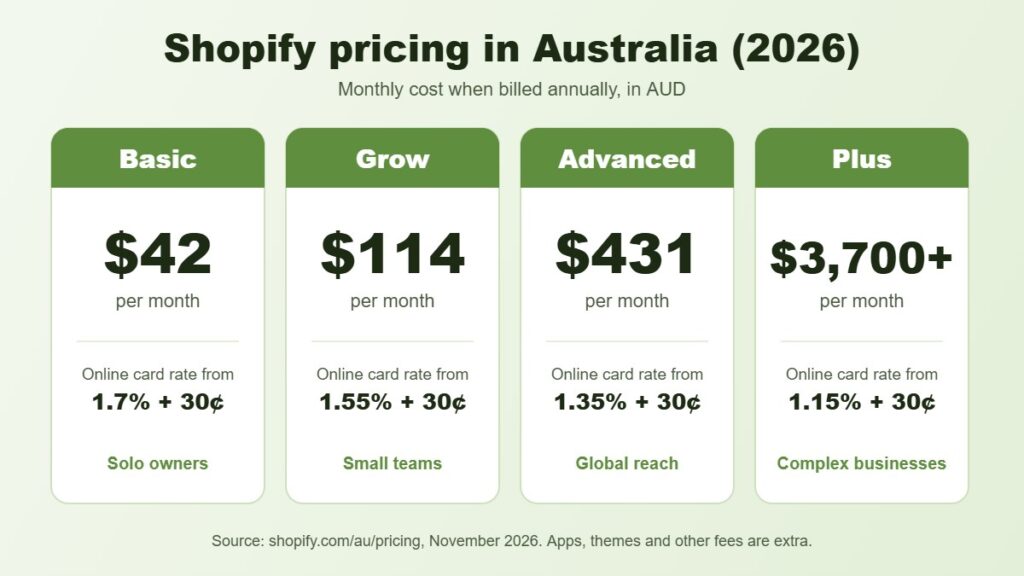
Shopify also offers monthly billing at different rates.
For example, the Basic plan costs A$56 per month when paid monthly instead of annually.
These prices don't necessarily include third-party apps, premium themes, payment processing charges or custom development.
Shopify plans include secure website hosting and an SSL certificate.
Always check the official Shopify Australia pricing page for current rates.
WooCommerce Pricing in Australia
WooCommerce's core plugin is free.
However, most WooCommerce stores have additional expenses.
These may include:
- WordPress website hosting.
- Domain name registration.
- Premium themes.
- Paid plugins and extensions.
- Payment processing fees.
- Website development and customisation.
- Security and backup services.
- Ongoing website maintenance.
WooCommerce's official pricing guide estimates hosting costs of US$25 to US$350 per month for many stores, although actual Australian hosting options and prices vary considerably.
Extensions may also involve recurring licence fees.
A smaller WooCommerce website using a reliable host and mostly free plugins may be relatively economical.
A more complex website requiring premium extensions, custom development and ongoing maintenance can cost significantly more.
Which is cheaper?
Neither platform is automatically cheaper.
Shopify provides more predictable core platform costs, while WooCommerce gives businesses greater control over which hosting and services they purchase.
The best comparison is the total cost of running the store over several years.
2. Which Platform Is Easier to Use?
For business owners managing their own online store, ease of use is important.
Shopify Ease of Use
Shopify is designed around everyday eCommerce tasks.
Store owners can manage products, collections, inventory, orders and discounts from a central administration interface.
Much of the technical infrastructure is managed by Shopify.
This generally makes it easier for businesses without technical experience to start selling online.
For example, adding a new product typically involves entering its title, description, images, price, variants and inventory information.
WooCommerce Ease of Use
WooCommerce uses the familiar WordPress administration interface.
For businesses already comfortable with WordPress, this can be an advantage.
Products, orders and website content can be managed within the same WordPress dashboard.
However, WooCommerce involves additional technical responsibilities.
Depending on the website, store owners may need to manage plugin updates, hosting configurations, backups and software compatibility.
Verdict: Shopify generally offers a simpler experience for new store owners. WooCommerce can be equally manageable when properly configured and maintained, especially for businesses already familiar with WordPress.
3. Shopify vs WooCommerce for SEO
Search engine optimisation is essential for businesses that want customers to discover their products through Google.
Both Shopify and WooCommerce can support effective SEO strategies.
However, they offer different levels of flexibility and technical control.
Shopify SEO Features
Shopify includes several built-in SEO capabilities.
Store owners can customise product titles, meta descriptions, URLs within supported path structures and image alt text.
Shopify also provides automatic XML sitemaps and canonical URL handling.
Product pages and collection pages can be optimised for relevant customer searches.
For example, an Australian fashion store might create a collection targeting the keyword "girls birthday dresses".
The collection could include a descriptive heading, useful content, relevant products and internal links.
Shopify is particularly convenient for businesses that want to manage product SEO without installing numerous extensions.
WooCommerce SEO Features
WooCommerce benefits from WordPress's flexible content management system.
Businesses can use established WordPress SEO plugins such as Yoast SEO or Rank Math to manage many aspects of technical and on-page optimisation.
WooCommerce also allows extensive control over website structure, blog content, category pages and custom templates.
For example, a business might build detailed buying guides, product comparisons, industry resources and service pages alongside its online store.
Which Platform Is Better for Google Rankings?
Neither Shopify nor WooCommerce automatically ranks better on Google simply because of the platform being used.
Google rankings depend on factors including content relevance, search intent, website accessibility, technical SEO and overall content quality.
Both platforms can rank well when properly implemented.
For businesses with a straightforward product catalogue, Shopify provides a practical SEO foundation.
For businesses requiring highly customised content structures, WooCommerce may offer additional flexibility through WordPress.
Read my related guide: Shopify SEO Checklist for Australian Online Stores in 2026.
4. Website Design and Customisation
Both Shopify and WooCommerce support professional, mobile-responsive website designs.
The main difference is how those designs are developed and maintained.
Shopify Website Design
Shopify provides a range of free and premium themes.
Modern Shopify themes support reusable sections, templates and dynamic content.
Developers can also build custom storefront experiences using Shopify Liquid, CSS, JavaScript and metafields.
For example, a Shopify product page could include technical specifications, compatible accessories, downloadable documents, product videos and custom information panels.
Changes can be developed in an unpublished theme before being applied to the live store.
However, certain checkout customisations and advanced features are restricted by Shopify's platform architecture or subscription requirements.
WooCommerce Website Design
WooCommerce works with WordPress themes and supports extensive custom development.
Developers can use custom themes, the WordPress block editor and appropriate page builders to create tailored website experiences.
Because WooCommerce is open source, developers have greater access to the underlying application code.
This can be useful for websites requiring unusual product workflows, customer dashboards or business-specific integrations.
However, extensive customisation also increases the importance of testing and ongoing maintenance.
Verdict: Both platforms offer strong design capabilities. WooCommerce provides more control over the underlying system, while Shopify offers a structured development environment with managed infrastructure.
5. Shopify vs WooCommerce Website Speed
Website performance affects the shopping experience.
Slow-loading product pages, delayed images and unresponsive navigation can make it difficult for visitors to browse products.
Both Shopify and WooCommerce can deliver fast online stores.
Shopify Performance
Shopify provides managed hosting and infrastructure designed for eCommerce websites.
Store owners don't need to configure a separate web server.
However, website performance can still be affected by oversized images, unnecessary apps, inefficient theme code and excessive third-party scripts.
WooCommerce Performance
WooCommerce performance depends heavily on its hosting environment, WordPress configuration and installed plugins.
A WooCommerce store running on suitable managed WordPress hosting can deliver excellent performance.
However, low-quality hosting, poorly coded themes or excessive plugins can create performance problems.
How to Compare Performance
Use Google PageSpeed Insights to test representative pages on both platforms.
Review Core Web Vitals, particularly:
- Largest Contentful Paint (LCP).
- Interaction to Next Paint (INP).
- Cumulative Layout Shift (CLS).
Test your homepage, important product pages and category or collection pages.
Verdict: Shopify reduces the amount of hosting administration required. WooCommerce offers more server-level control, but performance depends on how effectively the website is configured and maintained.
6. Payment Gateways and Transaction Fees in Australia
Australian online stores need reliable payment processing.
Both Shopify and WooCommerce can support popular payment methods.
Shopify Payments
Shopify Payments allows eligible businesses to accept card payments without integrating a separate external card processor.
At the time of writing, Shopify Basic advertises online card rates from 1.7% plus A$0.30 per transaction, with lower rates on higher plans.
Different rates can apply to American Express, international cards and other payment methods.
Additional third-party transaction fees may apply when Shopify Payments isn't used.
WooCommerce Payments
WooCommerce supports multiple payment providers, including WooPayments, Stripe and PayPal.
WooPayments currently lists an Australian base card rate of 1.75% plus A$0.30 per transaction.
International payments, currency conversion and alternative payment methods can involve additional charges.
WooCommerce itself doesn't impose an additional platform transaction fee simply for selecting a third-party payment provider.
Which Has Lower Payment Fees?
The best option depends on your payment provider, Shopify plan, transaction volume, payment methods and customer locations.
Compare actual processing rates rather than assuming that one platform always has cheaper payments.
For stores with significant sales volumes, even relatively small differences in processing fees can affect operating costs.
7. Shipping and Delivery for Australian Online Stores
Shipping is particularly important for Australian retailers because delivery costs can vary significantly between metropolitan and regional areas.
Both Shopify and WooCommerce allow businesses to configure shipping rates and integrate with shipping services.
Depending on the selected apps or extensions, stores may be able to connect with services such as Australia Post, Shippit or other fulfilment providers.
Important features to consider include:
- Flat-rate shipping.
- Free shipping thresholds.
- Shipping zones.
- Regional delivery pricing.
- Product weight and dimensions.
- Live carrier calculations.
- Tracking and fulfilment updates.
- Local pickup options.
Shopify Shipping
Shopify includes built-in shipping configuration tools and supports additional shipping functionality through apps.
Some advanced carrier-calculated shipping options depend on the subscription plan or eligibility.
WooCommerce Shipping
WooCommerce provides configurable shipping zones and methods.
Additional extensions can support specific Australian carriers and advanced shipping calculations.
Verdict: Both platforms can support Australian shipping requirements. The best solution depends on your product dimensions, shipping volumes, carrier accounts and required integrations.
8. Security and Website Maintenance
Website security is an important consideration for any online business.
Customers expect their payment and personal information to be handled securely.
Shopify Security
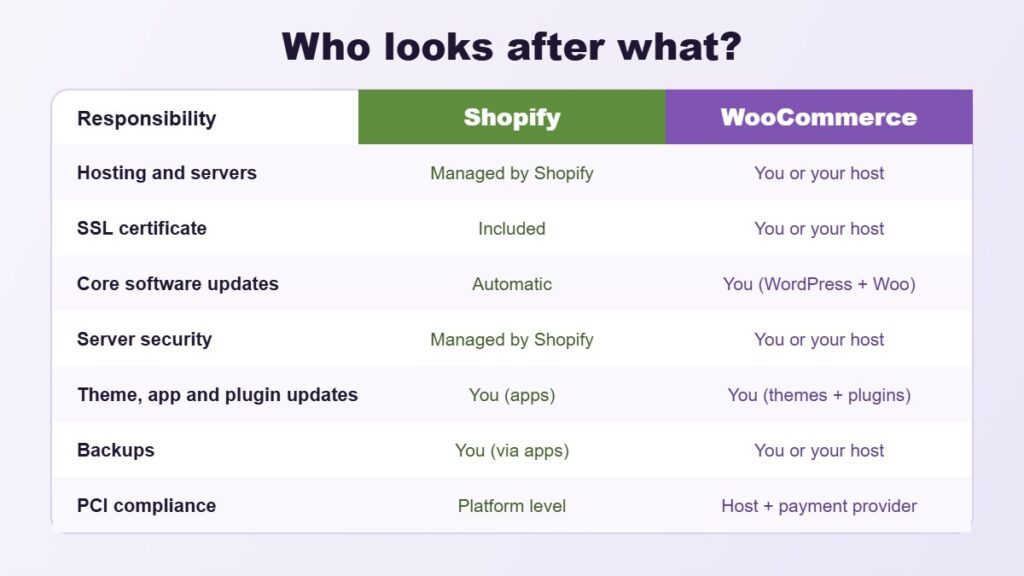
Shopify manages core platform hosting, infrastructure and many security responsibilities.
Its plans include SSL support and platform-level PCI compliance.
This reduces the need for store owners to manage server security and core platform upgrades.
However, businesses must still manage staff access, account authentication, third-party apps and other store settings responsibly.
WooCommerce Security
WooCommerce stores typically require more hands-on maintenance.
This includes keeping WordPress, WooCommerce, themes and plugins updated.
Website owners or their hosting providers must also manage appropriate backups, server security and monitoring.
WooCommerce actively develops security updates, but those updates still need to reach the website through suitable maintenance processes.
A professionally maintained WooCommerce store can be secure and reliable.
The important difference is how the responsibilities are managed.
Verdict: Shopify provides a more managed security environment. WooCommerce offers greater hosting and system control, along with additional maintenance responsibilities.
9. Which Platform Is Better for Content Marketing?
Some businesses use their websites primarily to sell products.
Others rely heavily on educational articles, service pages, guides and other content to attract customers.
Shopify Blogging
Shopify includes blogging functionality.
Businesses can create articles, publish buying guides and link visitors to relevant products and collections.
For straightforward eCommerce content marketing, this may be sufficient.
WooCommerce and WordPress Content Management
WordPress was built around flexible content management.
It supports pages, posts, custom post types, taxonomies and extensive editorial workflows.
Businesses can develop more complex content structures without relying entirely on external applications.
For example, a business might operate an online store alongside a large technical resource library, training portal or specialist publishing website.
WooCommerce allows this content and the store to operate within the same WordPress environment.
Verdict: Shopify is well suited to product-focused content marketing. WooCommerce is particularly attractive when content publishing is a major part of the business.
10. Shopify vs WooCommerce for Business Growth
Both Shopify and WooCommerce can support growing eCommerce businesses.
However, their approaches to scaling differ.
Growing With Shopify
Shopify offers different subscription levels and additional capabilities for more complex businesses.
Store owners can add products, expand sales channels, manage inventory and use Shopify Markets to support international selling.
Shopify handles much of the underlying infrastructure as the store grows.
This can make growth easier to manage for businesses without internal technical teams.
Growing With WooCommerce
WooCommerce can also support substantial product catalogues and complex business operations.
Businesses can customise hosting infrastructure and website functionality to suit their requirements.
However, higher traffic and more complex integrations may require additional hosting resources, development and ongoing performance management.
Verdict: Shopify offers convenient infrastructure management for growing retailers. WooCommerce provides extensive flexibility when businesses have the technical resources to maintain a more customised platform.
11. Shopify vs WooCommerce for Australian Small Businesses
The best choice depends on the type of business you operate.
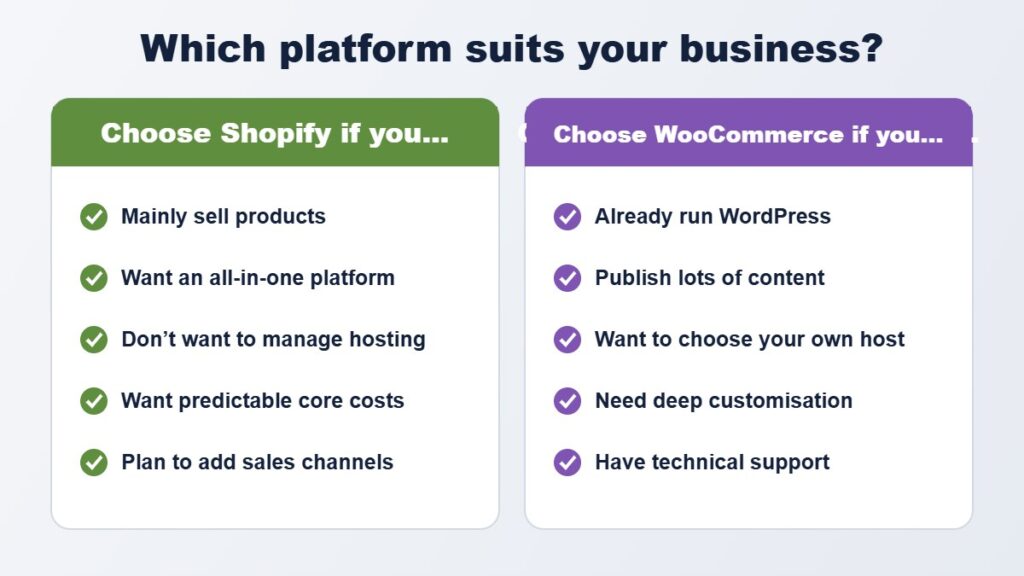
Choose Shopify If You:
- Primarily sell physical or digital products.
- Want an all-in-one eCommerce platform.
- Prefer not to manage hosting and server updates.
- Need straightforward product and inventory management.
- Want to launch with a professional theme.
- Prefer more predictable core platform costs.
- Plan to expand through additional sales channels.
Choose WooCommerce If You:
- Already operate an established WordPress website.
- Need substantial custom content functionality.
- Want to choose your own hosting provider.
- Require extensive application-level customisation.
- Prefer an open-source platform.
- Have access to suitable technical support.
- Need specialised WordPress integrations.
There isn't one correct answer for every business.
A small retailer with 50 products may be better served by Shopify, while a business offering services, downloadable resources and specialised product configuration may prefer WooCommerce.
The platform should fit the way your business operates.
12. Can You Migrate From WooCommerce to Shopify?
Yes. Businesses can migrate from WooCommerce to Shopify.
A migration may involve transferring products, customers, selected order history, collections or categories and other relevant information.
However, the process requires careful planning.
WooCommerce and Shopify use different database structures, URL formats and theme architectures.
Custom functions and integrations may need to be rebuilt or replaced.
Important Migration Considerations
Review your product information, including variants, images, pricing and inventory.
Identify which customer and order records need to be transferred.
Audit existing URLs and search engine rankings.
Plan suitable redirects for URLs that will change.
Rebuild or replace incompatible features.
Test shipping, payment methods and checkout functionality.
Verify analytics and tracking after migration.
A website migration can affect organic search performance, so SEO planning should be included from the beginning.
13. Can You Migrate From Shopify to WooCommerce?
Yes. Shopify stores can also be migrated to WooCommerce.
This might be appropriate for businesses that require greater control over their website infrastructure or want to consolidate eCommerce functionality within WordPress.
Products and other supported information can be transferred through suitable migration tools or custom development.
However, not every Shopify feature has an identical WooCommerce equivalent.
Subscription products, customer accounts, discounts, third-party apps and custom product information may require additional work.
Before migrating, compare the full development and maintenance costs against the benefits of changing platforms.
Switching platforms is not necessarily the best solution when existing problems could be resolved through targeted improvements.
Read more: Is Your Shopify Store Outdated? 12 Signs It's Time for a Redesign in 2026.
14. Which Platform Should You Choose for SEO in 2026?
Both platforms provide the technical foundations needed for search engine optimisation.
Shopify includes built-in tools that are convenient for managing product and collection SEO.
WooCommerce provides extensive content and technical flexibility through WordPress.
For most businesses, the greater opportunity comes from implementing SEO properly rather than changing platforms.
Important tasks include:
- Researching relevant customer search queries.
- Creating useful product and category content.
- Improving website navigation.
- Adding descriptive product image alt text.
- Monitoring Google Search Console.
- Implementing appropriate structured data.
- Maintaining website performance.
- Building relevant internal links.
- Publishing helpful buying guides and articles.
Changing from Shopify to WooCommerce, or the other way around, doesn't automatically improve rankings.
A well-maintained, properly optimised store on either platform can perform well in organic search.
15. How to Choose the Right eCommerce Developer
Choosing the platform is only one part of building a successful online store.
The quality of the website's design, development and ongoing maintenance is equally important.
Before hiring a developer, ask whether they have experience with your preferred platform.
For Shopify projects, relevant experience may include custom Shopify Liquid development, theme architecture, metafields, collections, integrations and SEO migration.
For WooCommerce projects, relevant experience may include WordPress development, PHP, custom themes, plugin compatibility, hosting and database management.
You should also ask about:
- Mobile-responsive website design.
- Product and category structure.
- Search engine optimisation.
- Payment and shipping configuration.
- Website speed and performance.
- Security and maintenance.
- Analytics and conversion tracking.
- Post-launch technical support.
The right developer should explain the advantages and limitations of each platform and recommend a solution based on your actual requirements.
Frequently Asked Questions About Shopify vs WooCommerce
Is Shopify better than WooCommerce for beginners?
Shopify is generally easier for beginners because hosting, checkout and many technical services are managed within the platform. WooCommerce can also be user-friendly, particularly for businesses familiar with WordPress, but requires additional setup and maintenance.
Is WooCommerce really free?
WooCommerce's core plugin is free to download and use. However, hosting, domain registration, premium extensions, payment processing and development can involve additional costs.
Which is better for SEO, Shopify or WooCommerce?
Both platforms can rank well on Google. Shopify provides useful built-in SEO features, while WooCommerce offers extensive technical and content flexibility through WordPress. Rankings depend on implementation and content quality rather than the platform alone.
Is Shopify more expensive than WooCommerce?
Not necessarily. Shopify has a recurring subscription fee, while WooCommerce requires separate hosting and potentially paid plugins. Total costs depend on your store's features, transaction volume and maintenance requirements.
Can I use my existing domain with Shopify or WooCommerce?
Yes. Both platforms support custom domains. You can normally retain your existing domain when launching or migrating a store, although DNS and hosting settings may need to be updated.
Does WooCommerce support Australian dollars and GST?
Yes. WooCommerce supports AUD pricing and tax configuration. Shopify also supports Australian currency and tax settings. Businesses should configure GST according to their registration status and applicable Australian tax requirements.
Can I sell internationally with Shopify and WooCommerce?
Yes. Both can support international sales. Shopify provides Markets features for regional selling, while WooCommerce can use appropriate payment, currency, shipping and localisation extensions.
Which is better for a small Australian clothing store?
Shopify is often a practical option for product-focused clothing retailers because of its inventory management, product variants, themes and managed infrastructure. WooCommerce may be preferable when the business already has a substantial WordPress website or requires specialised functionality.
Should I move my existing WooCommerce store to Shopify?
Only if Shopify provides a meaningful advantage for your business. Consider operational requirements, existing customisations, hosting costs, maintenance and migration risks before deciding.
Final Verdict: Shopify or WooCommerce for Australian Businesses?
Both Shopify and WooCommerce are capable eCommerce platforms.
Shopify is generally the better starting point for businesses that want a straightforward online store with managed hosting, integrated commerce features and less technical maintenance.
WooCommerce is often the better choice for businesses that already use WordPress or require extensive control over their website's content, infrastructure and functionality.
The decision shouldn't be based on subscription pricing alone.
Consider the total cost of ownership, the amount of customisation you need, your internal technical resources and how you expect your business to grow.
For an established business, it's also worth investigating whether your existing platform can be improved before committing to a migration.
A well-planned online store should be easy for customers to use, manageable for your team and flexible enough to support your future goals.
Need Help With Shopify or WooCommerce Development in Australia?
At iScreenviewer, I provide eCommerce website development, redesign, SEO and ongoing technical support for Australian businesses.
I work directly with business owners to plan, build and improve their online stores.
Whether you're starting a new business, upgrading an outdated Shopify theme, improving a WooCommerce website or considering a migration between platforms, I can help you assess your options.
My eCommerce Development Services
- Shopify website design and development.
- Custom Shopify theme development.
- WooCommerce website development.
- WordPress customisation and maintenance.
- Product and collection SEO optimisation.
- eCommerce website redesigns.
- Payment and shipping integrations.
- Google Analytics 4 and Search Console setup.
- Website performance improvements.
- Platform migrations and technical support.
You work directly with the developer completing your project, with clear communication and practical recommendations.
Based in Sydney, I work with businesses throughout Australia.
Explore iScreenviewer eCommerce Development Services
Contact iScreenviewer to Discuss Your Online Store
Share your website URL, business requirements and the features you need. I'll help you identify a suitable platform and provide a clear quote for your project.
Fixed-Price Packages That Can Help

Prefer to have it done for you? These fixed-price packages cover the work in this guide, with no hourly billing:
- Shopify Store Setup: A$1,290
- WooCommerce Store Setup and Styling: A$899
- Full Rebuild Shopify Website: A$1,500
Not sure which one you need? Book a free website consultation or request a custom quote.