

If your business website looks outdated, loads slowly or isn't generating enough enquiries, you may be considering a redesign.
One of the first questions most Australian business owners ask is:
How much does it cost to redesign a website?
The answer depends on your existing website, the platform you're using and how much work is required.
A small WordPress website may only need updated layouts, improved mobile responsiveness and better content. An established Shopify store might require a complete theme rebuild, product page improvements, SEO migration and third-party integrations.
In 2026, an Australian small business website refresh might cost between $1,500 and $4,000, while a more comprehensive redesign can range from $3,500 to $10,000 or more. Complex eCommerce and custom development projects can cost considerably more.
These are indicative Australian market budgeting ranges, not fixed quotations. The final price depends on project scope, and you should always confirm whether GST is included.
Key takeaways: A basic website refresh in Australia typically costs $1,500 to $4,000. A full small business redesign is usually $3,500 to $10,000. WordPress redesigns commonly range from $3,500 to $12,000, and Shopify or WooCommerce redesigns from $5,000 to $20,000. Custom rebuilds start around $10,000. Scope, integrations, content and SEO migration matter more than page count.
In this guide, I'll explain what influences website redesign pricing, how WordPress and Shopify projects compare, what costs you should expect after launch and how to make the most of your website budget.
How Much Does a Website Redesign Cost in Australia?
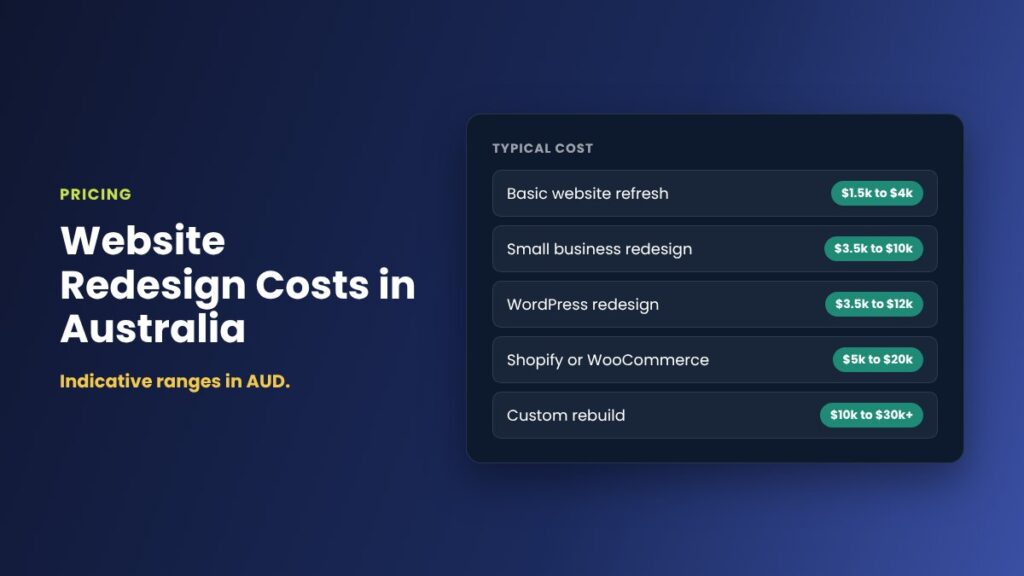
Website redesign costs vary depending on the size, complexity and condition of your existing website.
The following figures provide a starting point for budgeting in 2026.
| Website redesign type | Indicative cost (AUD) |
|---|---|
| Basic website refresh | $1,500 to $4,000 |
| Small business website redesign | $3,500 to $10,000 |
| WordPress website redesign | $3,500 to $12,000 |
| Shopify or WooCommerce redesign | $5,000 to $20,000 |
| Custom website rebuild | $10,000 to $30,000+ |
| Large or enterprise website | $30,000+ |
These ranges overlap because the work involved is often more important than the platform or number of pages.
For example, a five-page WordPress website with custom animations and complex integrations could cost more to redesign than a 15-page website using straightforward, reusable layouts.
Similarly, a Shopify store with hundreds of existing products may be relatively simple to redesign if its catalogue and integrations remain unchanged.
The key is understanding exactly what you're paying for.
1. What's the Difference Between a Website Refresh, Redesign and Rebuild?
Before requesting quotes, it's useful to understand the type of project your business needs.
Website Refresh
A website refresh focuses on improving the appearance and usability of an existing website without significantly changing its underlying structure.
Typical improvements include:
- Updating colours, typography and branding.
- Replacing outdated banners and imagery.
- Improving spacing and page layouts.
- Refining navigation and mobile presentation.
- Updating calls to action and contact forms.
- Making smaller performance improvements.
A website refresh is often the most cost-effective choice when the existing platform is secure, supported and functioning well.
Indicative budget: $1,500 to $4,000.
Full Website Redesign
A redesign involves rethinking the website's visual presentation, page layouts, user experience and sometimes its content structure.
It may include new templates, reorganised navigation, redesigned service pages and improvements to technical SEO.
The existing content management system, domain and hosting may remain unchanged.
Indicative budget: $3,500 to $10,000 for many small business websites.
Complete Website Rebuild
A rebuild involves developing the website on new technical foundations.
This may be necessary when your existing website uses outdated technology, has significant security or maintenance issues, or no longer supports your business requirements.
A rebuild can involve migrating content, integrating new systems and changing platforms.
Indicative budget: $10,000 to $30,000+, depending on complexity.
Not every outdated website needs a complete rebuild. In many cases, improving the existing platform can provide better value.
2. How Much Does a WordPress Website Redesign Cost?
WordPress remains a popular choice for Australian small businesses because of its flexibility and content management capabilities.
The cost of redesigning a WordPress website depends heavily on how it was originally built.
A website using a well-maintained theme and straightforward page layouts may be relatively easy to update.
However, a heavily customised website with multiple plugins, custom post types and advanced functionality can require more development work.
Basic WordPress Redesign
A smaller WordPress redesign may include updated page templates, new imagery, improved mobile layouts and basic SEO checks.
This can suit businesses with a relatively simple website that already functions properly.
Custom WordPress Redesign
A custom WordPress project may involve:
- Developing or rebuilding a custom theme.
- Creating reusable page components.
- Improving content management through custom fields.
- Integrating enquiry forms and third-party services.
- Updating navigation and website architecture.
- Improving loading performance.
- Reviewing technical SEO and redirects.
- Testing desktop and mobile functionality.
If your website uses Elementor, Advanced Custom Fields or a custom theme, the developer should review the existing setup before recommending changes.
Sometimes retaining working components is more economical than replacing the entire website.
Indicative WordPress redesign budget: $3,500 to $12,000, with more complex projects costing additional amounts.
3. How Much Does a Shopify Website Redesign Cost?
Shopify website redesign projects can vary significantly in price.
Some businesses only need their existing theme updated, while others require custom storefront development.
For example, a small fashion retailer might want a cleaner homepage, improved collection pages and better mobile navigation.
A larger eCommerce business may need custom product templates, advanced filtering, product metafields and integrations with external systems.
Shopify Theme Refresh
A smaller Shopify redesign could involve updating an existing supported theme, improving homepage sections and refining the product and collection layouts.
This may be sufficient for stores where the underlying theme is modern and functioning correctly.
Custom Shopify Redesign
More advanced Shopify development can include:
- Custom homepage and collection sections.
- Redesigned product pages.
- Shopify Liquid theme development.
- Mobile navigation and search improvements.
- Product metafields and dynamic content.
- Custom product filtering.
- App integrations.
- SEO migration and redirects.
- Performance optimisation.
- Testing payment, cart and checkout functionality.
The number of products does not necessarily determine the redesign cost.
A Shopify store with 1,000 products can be easier to redesign than a smaller store with complex product configuration and custom business rules.
Indicative Shopify redesign budget: $5,000 to $20,000, with simpler theme updates potentially costing less.
For more information, read my guide on 12 signs your Shopify store needs a redesign. If you're redesigning a store, my Shopify SEO checklist for Australian online stores is also worth reviewing before launch.
4. What Affects Website Redesign Pricing?
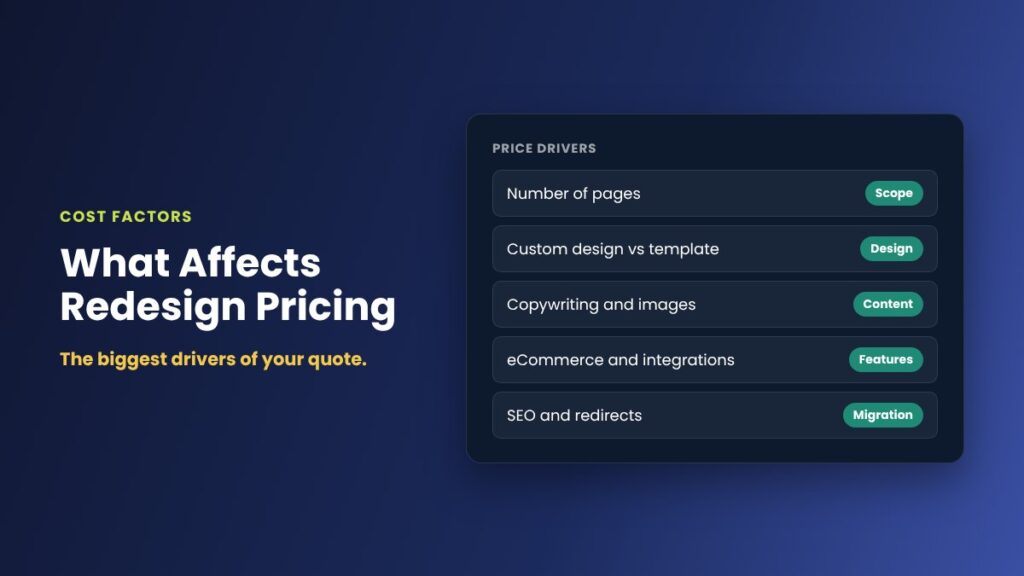
Several factors influence the cost of a website redesign in Australia.
Understanding these factors will help you compare quotes and avoid unnecessary expenses.
Number of Pages and Templates
A website with five straightforward pages generally requires less work than one with 50 different layouts.
However, page count alone isn't enough to determine the price.
If several pages share the same template, they may be easier to develop and maintain.
For example, a WordPress website might use one template for 20 service-area pages rather than 20 individually designed layouts.
Custom Design Requirements
Using an existing theme can reduce initial development costs.
A custom-designed website typically requires more planning, wireframing, design work and testing.
Custom design is useful when your brand or business requirements cannot be supported effectively through an existing theme.
Existing Website Condition
An older website may contain broken layouts, outdated plugins, unsupported theme code or unnecessary integrations.
Fixing these problems can increase the project scope.
In some cases, replacing the technical foundation is more economical than repeatedly repairing the existing implementation.
Content Writing and SEO
Website copywriting, keyword research and search engine optimisation may be included in a redesign quote or charged separately.
If your existing content is useful and accurate, much of it may be reusable.
If pages need to be rewritten, reorganised or created from scratch, additional content work will be required.
Third-Party Integrations
Many business websites connect to external systems.
Examples include payment gateways, CRM platforms, booking systems, email marketing services, inventory software and shipping providers.
These integrations need to be reviewed and tested during a redesign.
Some can be retained without significant changes, while others require new development.
Website Migration
Moving from one platform to another can introduce additional work.
For example, migrating from an older website builder to WordPress may require content restructuring and new templates.
Moving an eCommerce website from WooCommerce to Shopify can be more complicated because products, customer information, orders and platform-specific functionality need careful handling.
Migration planning should be included in the project scope.
5. Should You Choose a Freelancer or Web Design Agency?
Australian businesses can choose between freelance web developers, small studios and larger digital agencies.
Each option has advantages.
Working With a Freelance Web Developer
A freelancer may be suitable for businesses that want direct communication with the person designing and developing their website.
Potential benefits include:
- Direct communication with the developer.
- Flexible project scope.
- Less administrative overhead.
- Support for smaller improvements and ongoing work.
- Continuity between development and maintenance.
A freelancer can be particularly useful when your project requires hands-on technical work rather than a large creative or marketing team.
However, it's important to confirm their experience, availability and ability to support the platforms your business uses.
Working With a Web Design Agency
An agency may be appropriate for larger projects that require several specialists.
Depending on the agency, the team may include designers, developers, project managers, copywriters and SEO specialists.
This can be beneficial for substantial branding projects, complex digital platforms or businesses requiring multiple services at once.
The most important consideration is choosing someone who understands your requirements and can deliver and maintain the website effectively.
6. What Is Usually Included in a Website Redesign Quote?
Website redesign quotes can look similar while covering very different amounts of work.
Before accepting a proposal, review exactly what is included.
A well-defined quote should explain the project scope, deliverables, payment terms and any ongoing charges.
Common inclusions may cover:
Planning and website review
An initial discussion about your business, current website and goals.
Website design
Homepage design, typography, colours, page layouts and mobile responsiveness.
Development
Building the approved design using WordPress, Shopify or another appropriate platform.
Content migration
Transferring agreed pages, images and other website content.
Basic technical SEO
Reviewing page headings, important metadata, mobile usability and relevant technical settings.
Testing
Checking important pages, enquiry forms, navigation and website functionality.
Launch
Publishing the new website or theme and performing initial checks.
Handover
Providing access, basic guidance and documentation where required.
Don't assume every quote includes all these services.
For example, comprehensive keyword research, copywriting, photography and ongoing SEO are often separate services.
7. Hidden Website Redesign Costs Australian Businesses Should Know
The initial design and development price isn't always the complete cost of running a website.
Some expenses are ongoing, while others depend on the features you choose.
Domain Name Renewal
Your domain registration normally has a recurring renewal cost.
This may be annual or cover a longer registration period.
Website Hosting
WordPress and other self-hosted websites generally require a hosting plan.
Hosting costs depend on the provider, resources, traffic and level of management required.
Shopify includes hosting within its subscription, so a separate standard web hosting plan is generally unnecessary.
Premium Themes and Plugins
Some WordPress plugins and themes have annual licence fees.
Shopify stores may also use paid themes or third-party applications with recurring subscriptions.
Ongoing Website Maintenance
WordPress websites require maintenance such as software updates, backups, security monitoring and compatibility checks.
Shopify handles much of its core hosting infrastructure, but custom themes, apps, content and integrations still require attention.
SEO and Marketing
A website redesign may include technical SEO foundations, but ongoing search optimisation usually requires additional work.
This can involve creating new content, improving collection pages, reviewing keyword performance and monitoring Google Search Console.
Additional Functionality
Features such as booking systems, advanced product filters, custom forms and external API integrations may cost extra if they weren't included in the original quote.
Before starting, ask for a clear breakdown of one-off development costs and recurring expenses.
8. How Much Does It Cost to Maintain a Website After Redesign?
Website maintenance costs depend on the platform and the level of support required.
A basic business website may only need periodic software updates, backups and minor content changes.
An active eCommerce website often requires more frequent attention because products, marketing campaigns and integrations change regularly.
For example, a maintenance arrangement might cover:
- WordPress plugin and theme updates.
- Security monitoring and backups.
- Website performance checks.
- Content and image updates.
- Troubleshooting forms and integrations.
- Product and collection updates.
- SEO monitoring and improvements.
- Google Analytics and Search Console support.
Some businesses prefer a fixed monthly maintenance arrangement.
Others prefer to request development assistance as needed.
The right approach depends on how often your website changes and how important it is to your daily operations.
For Shopify stores, AI tools can also make routine product and content updates faster after launch. Learn how to use Claude AI with Shopify to manage and grow your online store.
9. Can a Website Redesign Improve SEO and Google Rankings?
A website redesign creates opportunities to improve technical SEO, content and usability.
However, redesigning a website doesn't automatically improve Google rankings.
If your existing website already receives organic search traffic, it's important to protect that visibility during development and launch.
SEO Tasks to Include During a Redesign
- Review the existing website's important pages and search performance before making changes.
- Identify URLs that generate organic traffic or have valuable backlinks.
- Keep successful URLs unchanged where practical.
- If URLs must change, create relevant permanent redirects.
- Preserve useful content and ensure important headings and metadata are carried over or improved.
- Check canonical tags, structured data and indexing settings.
- Test the new website's internal links, sitemaps and mobile experience.
- Monitor Google Search Console following launch.
Google recommends planning URL mapping, redirects, testing and ongoing monitoring when changing website URLs.
A poorly planned migration can result in unnecessary indexing problems and changes in organic search traffic.
SEO protection should be included in the redesign scope, not treated as an afterthought.
10. Is It Cheaper to Redesign Your Existing Website or Build a New One?
The cheapest option depends on the condition of your current website.
If your website already uses a modern, supported platform and its structure is suitable, improving the existing design may be the better choice.
For example, a WordPress website with a working theme, reliable plugins and well-organised content might only need a visual refresh.
However, an older website with unsupported code and extensive technical problems could cost more to repair than rebuild.
When to Keep Your Existing Website
Consider retaining the current website when its platform is supported, its content structure works and the problems are limited to design or smaller technical issues.
When to Rebuild
A rebuild may make sense when your website is difficult to maintain, relies on outdated technology or requires major functionality changes.
The decision should be based on a technical review rather than the website's age alone.
A good developer should explain which parts of your existing website can be retained and which genuinely need replacing.
11. Example Website Redesign Budgets
Every project is different, but hypothetical examples can help explain what different budgets might cover.
Example A: Local Service Business
Budget: $4,000 to $6,000
A local service business has an existing WordPress website with six pages.
The website is functional, but the design is outdated and the mobile experience needs improvement.
The project might involve new page layouts, updated imagery, improved navigation, refreshed content, better enquiry forms and basic technical SEO.
Existing content and functionality are reused where appropriate.
Example B: Australian Shopify Store
Budget: $7,000 to $12,000
An established Shopify retailer wants to modernise its storefront.
The project involves an updated theme, redesigned homepage, improved collection pages, product template changes, mobile navigation improvements and compatibility testing.
The existing catalogue, payment configuration and order history remain within Shopify.
Additional custom integrations would be quoted separately.
Example C: Established Business Website
Budget: $12,000 to $20,000
A growing business needs a custom WordPress website with multiple services, location pages and content templates.
The project includes new information architecture, reusable custom components, content migration, SEO redirects and third-party CRM integration.
The larger budget reflects the additional planning, development and testing required.
These examples are illustrative budgeting scenarios, not fixed packages or published iScreenviewer prices.
12. How to Reduce Website Redesign Costs Without Sacrificing Quality
A website redesign doesn't need to include every possible improvement at once.
There are several ways to manage your budget while still achieving a useful result.
Prioritise Important Pages
Start with your homepage, major service pages, important collections and pages that generate enquiries or sales.
Less important sections can often be improved later.
Reuse Good Existing Content
If your current website has accurate and helpful content, it may not need to be rewritten.
Review and improve what already works before paying for entirely new copy.
AI writing tools can help draft or tidy existing content, but every page should still be checked for accuracy and brand voice. See how ChatGPT is being used in businesses.
Choose the Right Platform
WordPress and Shopify can both support professional websites, but they're designed for different requirements.
Choose the platform based on your business needs rather than simply following trends.
If your website runs on Umbraco, it can also support eCommerce. Read how to run an online store with Vendr and Umbraco.
Avoid Unnecessary Custom Development
Custom features can be valuable, but they also increase development and maintenance requirements.
Use reliable existing functionality where it meets your needs.
Plan Your Requirements Early
Provide your developer with examples, content, branding assets and a clear explanation of your goals.
Well-defined requirements can reduce repeated design changes and unexpected project costs.
Build in Phases
For larger projects, consider dividing development into manageable stages.
For example, you might improve the core website first and add advanced integrations or marketing features later.
This allows you to prioritise the work that matters most.
13. How Do You Know Whether a Website Redesign Is Worth the Investment?
The value of a redesign should be assessed against your business goals.
A better-looking website can improve brand presentation, but appearance alone isn't the only measure of success.
Consider whether the redesign could help customers find information faster, make enquiries more easily, discover products or complete purchases with less frustration.
Useful metrics include:
- Enquiries generated through the website.
- Online sales and conversion rates.
- Organic search traffic.
- Product and collection engagement.
- Mobile usability.
- Website speed and reliability.
- Time spent updating website content.
For example, if a business receives regular website enquiries but visitors struggle to complete its contact form, improving that process may be more valuable than redesigning every page.
For online retailers, improving product discovery or making product information clearer may provide greater value than purely decorative changes.
The best website redesign addresses real business problems and provides a foundation for ongoing improvements.
14. Questions to Ask Before Hiring a Website Developer
Before choosing a developer or agency, it's worth asking a few important questions.
What exactly is included in the quoted price?
Request a written scope of work explaining the pages, features and services included.
Will I own and control my website?
Confirm access to your website, domain, hosting and relevant third-party accounts.
Will my existing SEO be protected?
Ask about redirects, content migration, metadata and post-launch monitoring.
Can I update the website myself?
Understand how you'll manage text, images, products and other content.
Will the website be tested on mobile devices?
Mobile usability should be included in development and quality assurance.
What happens after launch?
Ask whether maintenance, support and training are available.
Are there ongoing fees?
Confirm hosting, platform subscriptions, app licences and maintenance expenses.
A clear quote makes it easier to understand what you're buying and compare providers fairly.
15. How to Get an Accurate Website Redesign Quote
The best way to get an accurate price is to have your current website reviewed.
A developer can assess its structure, technology, content and functionality before recommending a suitable approach.
When requesting a quote, try to provide:
- Your current website URL.
- The platform you're using, if known.
- What you dislike about the existing website.
- Examples of websites or designs you like.
- The main services or products your business offers.
- Any new functionality you need.
- Your preferred project budget.
- Whether you need ongoing support.
You don't need to prepare a detailed technical specification.
A clear description of your business and the problems you're trying to solve is often enough to begin the conversation.
Frequently Asked Questions About Website Redesign Costs
How much does a small business website redesign cost in Australia?
A straightforward website refresh may cost around $1,500 to $4,000, while a more comprehensive small business redesign might cost $3,500 to $10,000 or more. The final price depends on the design, content, technical requirements and other included services.
How much does it cost to redesign a five-page website?
A simple five-page website can cost less than a larger custom project, but the number of pages alone doesn't determine the price. Existing content, theme structure, forms, integrations and design requirements all affect the amount of work involved.
How much does a Shopify website redesign cost?
A professional Shopify redesign may cost approximately $5,000 to $20,000, although smaller theme improvements can cost less. Custom storefronts, advanced integrations and extensive development may require larger budgets.
Is WordPress cheaper than Shopify?
It depends on the project. WordPress has no mandatory platform subscription for the core software, but hosting, plugins, maintenance and development still cost money. Shopify has recurring subscription fees and may require paid themes or apps. Compare the total cost of ownership rather than the initial build price alone.
Can I keep my existing domain name?
Yes. In most cases, a website can be redesigned while retaining its existing domain name. DNS, hosting or platform settings may need to change depending on how the new website is launched.
Will a website redesign affect my Google rankings?
It can. Changes to content, URLs, internal links and technical settings may affect organic search performance. Careful SEO planning and migration testing help minimise avoidable problems, although rankings can still fluctuate after significant changes.
How long does a website redesign take?
A simple refresh may take a relatively short development period, while custom redesigns and larger eCommerce projects can require several weeks or longer. The timeline depends on design approvals, content readiness, development complexity and testing.
Do I need to pay for website maintenance after the redesign?
Ongoing maintenance is recommended, especially for WordPress websites that require regular software and security updates. Shopify stores also benefit from ongoing theme, app, content and performance reviews.
Final Thoughts: How Much Should You Budget for a Website Redesign?
Website redesign costs in Australia vary because every website has different requirements.
For a small business with a functional website, improving the existing design may be the most economical option.
Businesses requiring major structural changes, custom functionality or an eCommerce rebuild should allow a larger budget.
The most important step is understanding the condition of your current website and defining what you want the redesign to achieve.
A well-planned redesign should improve more than appearance. It should make your website easier to use, easier to maintain and better suited to your business goals.
Before investing in a complete rebuild, it's worth getting an experienced developer to review whether targeted improvements could achieve the same result.
Related Articles
Planning a redesign or improving your current website? These guides may also help:
- Is Your Shopify Store Outdated? 12 Signs It’s Time for a Redesign in 2026
- Shopify SEO Checklist for Australian Online Stores in 2026
- How to Use Claude AI with Shopify to Manage and Grow Your Online Store
- Run an Online Store with Vendr and Umbraco
- How ChatGPT Is Being Used in Businesses
- How Much Do Website Services Cost? 2026 Price Guide for Small Businesses
- UX/UI Design for Small Business Websites: Wireframes, Prototypes and User Journeys
- How to Brief a Web Developer: 6 Things to Know Before You Start
Browse all website, SEO and eCommerce articles.
Need a Website Redesign Quote in Australia?
At iScreenviewer, I work directly with Australian businesses to design, develop and improve their websites.
I provide hands-on web development and technical support across WordPress, Shopify, WooCommerce, Magento and Umbraco.
Whether you need a small website refresh, an updated Shopify theme, a custom WordPress build or a complete website redesign, I can review your existing setup and help identify a practical solution.
Website Redesign Services
- WordPress website redesign and development.
- Shopify theme upgrades and customisation.
- WooCommerce and Magento improvements.
- Mobile-responsive website design.
- Website speed and performance optimisation.
- Technical SEO and website migration.
- Google Analytics and Search Console setup.
- Website hosting, maintenance and support.
You deal directly with the developer working on your project, without unnecessary handovers or agency layers.
Based in Sydney, I work with businesses across Australia.
Explore My Website Design and Development Services
Request a Website Redesign Quote
Share your existing website URL, what you'd like to improve and any examples of designs you like. I'll review your requirements and provide a clear quote for the work involved.
Fixed-Price Packages That Can Help
Prefer to have it done for you? These fixed-price packages cover the work in this guide, with no hourly billing:
- Website Re-skin: Design Refresh: A$990
- WordPress Website: A$1,490
- Full Rebuild Shopify Website: A$1,500
Not sure which one you need? Book a free website consultation or request a custom quote.